Entradas

Mostrando las entradas etiquetadas como Consejos para Expatriados

10 Consejos para Expatriados

Los 10 consejos para afrontar una Expatriación La Expatriación es un reto personal y profesional que se afronta con gran ilusión. Si yo fuera a iniciar una Expatriación tendría en cuenta los siguientes 10 aspectos:

Expatriación o Asignación Internacional a largo plazo

Imagen
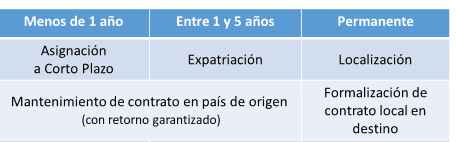
En el lenguaje común hablamos de un expatriado cuando nos referimos a una persona que está residiendo en un país distinto de su país de origen. En el mercado laboral, y desde una perspectiva más técnica, se suele entender este concepto de una forma más restringida: La Expatriación es un  traslado internacional temporal   con compromiso de retorno a l país de origen, que se incentiva con ciertas compensaciones y ayudas  temporales durante el tiempo que dura la asignación. Las Expatriaciones suelen tener un horizonte temporal de entre 1 y 5 años, conllevan el mantenimiento del contrato en el país de origen. Este concepto se distingue de las asignaciones a corto plazo que suelen ser por un periodo inferior al año (aunque luego se puedan prolongar) y de los traslados permanentes que suelen conllevar la formalización de un contrato local en el país de destino. (Otras definiciones ponen el límite de la asignación a corto plazo en los 6 me...

If I were an Expat (10/10): The 10 points to consider

If I were an expat about to start my assignment, these are the 10 points that I would keep in mind: Manage your own career : Before making the decision of working abroad, think how it improves your capabilities and your long term career perspectives. It is important to keep in mind that you are in the dri ving seat of what is coming ahead in your professional career. Total Compensation: The acceptance of an expatriation depends on the assessment of all benefits, not only the monetary ones such as salary, housing, etc. In recent years, professional, personal and family reasons are gaining importance, as the experience of working abroad is generally a very positive experience for the career of the expats and for their families. Family : If you want the assignment to be successful, the family deserves your full attention, especially during the first months. A ccording to recent studies, the most common argument for the...
If I were an Expat (8/10): During the assignment

Imagen
In previous posts we have discussed the importance of obtaining the immigration visa, the relocation process, the expat letter, taxation and other preliminary topics. Once we arrive in our country of destination, there are some questions that can help us in our landing to make it as smooth as posible. It is important to ensure your family adapts to the new country and culture. Family: Nothing helps you more than knowing that your family is adapting nicely to the new environment so you can focus on your job. In this context, companies do very well taking care of your family and investing in anything that can facilitate their landing. However, it is essential that, for at least the first few weeks you devote time to your family. Do activities with them over the weekend and spend the first moments together. Also, do not be shy and ask your manager or contacts in the destination country to introduce you to other expatriates. In many cases, your...

If I were an Expat (9/10): The return

It is advisable to start preparing your return a few months before the end of your assignment. In most cases, the Expatriation is agreed for a maximum of 2 or 3 years. Then, you may be offered an extension but the total length is normally 5 years or less. T alk to your bosses and find out what they have in mind before you start planning for your return. If you are asked to stay and you reach an agreement to continue the assignment, all you have to do is make the necessary arrangements to extend your stay: Sign an addendum to the Assignment letter Confirm the validity of the visa during the extended period Notify the landlord of the lengthening of the rental, register your kids in the following school year,   etc. Once the extension has been ruled out, the time is ripe to plan for the return.   In regards to personal and family matters, remember: Giving advance notice to your landlord and preparing for you...

What is Tax Equalization?

Tax  Equalization is an agreement whereby the Company offers the Expatriates a certain tax protection that is intended to maintain the same tax burden as if they had not moved from their country of origin . This is a complex matter. One of the most important topics as an Expat is to understand your tax implications. In short, t here are two basic tax policies around this topic: Gross Compensation : In this scheme, any compensation paid by the company is defined in gross terms (i.e. before taxes), being the Expat the risk taker of lower or higher taxes to be paid during the assignment. Tax Equalization : in this case, the company offers the expatriate a certain tax protection that is intended to maintain the same tax burden (in relation to their employment with the company) as if they had not moved from their country of origin. The advantage of this alternative is that it allows the company and the Expat to negotiate neglecting t...

1.000 preguntas sobre Expatriación

Se acaba de publicar el Memento  1.000 preguntas sobre expatriación . Es un libro técnico, dirigido a gestores de Expatriados, en el que se responden muchas de las dudas que surgen en un proceso de traslado internacional. Está editado por la Editorial Francis Lefebvre (@ EdicionesFL) en un formato cómodo y bien estructurado en 4 capítulos: Normativa laboral Normativa de Seguridad Social Normativa fiscal Normativa migratoria La alta calidad técnica de las respuestas hace de este libro una poderosa ayuda técnica en este complejo mundo. Desde aquí le doy la enhorabuena a sus promotores por la iniciativa, y les animo a revisar periódicamente el contenido para mantener la vigencia del texto.

If I were an Expat (6/10): Taxes

Benjamin Franklin said  "Our new Constitution is now established, and has an appearance that promises permanency; but in this world nothing can be said to be certain, except death and taxes ."   Attributed to Einstein, " The hardest thing in the world to understand is the income tax " If understanding taxes is difficult, understanding taxes simultaneously in two different countries is even worse. T here is no supranational authority that  effectively coordinates the definition of tax policies internationally and that is somethig we find out when we become an Expat. Let's start with an example, the tax year is different in many countries:   • Spain: January to December • Australia: July to June • UK: April to April   The beginning and the end of assignments can occur at any time of the year and depending on the day you start or end your expatriation, you will have a different tax tr...

If I were an Expat (5/10): The importance of Visas

The need for a  visa ( short for the Latin " carta visa")  is a formal barrier that hinders the international mobility of job seekers. It is not the only hurdle we find when we move abroad in search of a professional opportunity, as we also have language, academic validations, social security coverage and cultural barriers. For EU member citizens, our job market has expanded extraordinarily in recent years; currently our labor market is the European Union . Free movement of workers is a fundamental principle of the European Union Treaty that entitles EU citizens  to: look for a job in another EU country     work there without needing a work permit reside there for that purpose stay there even after employment has finished enjoy equal treatment with nationals in access to employment, working conditions and all other social and tax advantages EU nationals may also have certain types of health ...

If I were an #Expat (4/10): Before you sign the Expat letter

The Expat Letter represents the formal acceptance of the international assignment. It is important to understand the key aspects of your contract before proceeding with the signature. First, we must be clear on what kind of assignment we are being offered. The most common figure remains the Expatriate : a temporary transfer with return engagement maintaining the economic conditions of the home country providing certain compensation and temporary benefits to the employees and their families during the assignment. However, more and more employees are taking the initiative of working abroad in search of career opportunities or an international experience. In this context, International permanent transfers are gaining momentum: a permanent transfer, which usually means resigning in the home country with economic and labor conditions similar to a local  employee in the country of  destination (this is why i...

¿Trabajar fuera? Claves para la expatriación

Se publicó en noviembre del año pasado un libro dedicado al mundo de la Expatriación "¿Trabajar fuera?" Claves para la expatriación dentro de la Biblioteca FUNDIPE de la Editorial LID (@ lideditorial) .  Se trata de un manual práctico que aborda la Expatriación desde diferentes ángulos: la compensación, los beneficios, aspectos migratorios, laborales, seguridad social, fiscalidad, etc. Me ha gustado el enfoque práctico, y en especial, cómo se deja notar que está escrito por profundos conocedores de la materia. En el libro se describe la evolución de las prácticas de Expatriación en los últimos años y nos da algunas recomendaciones que me parecen muy relevantes en el momento actual. Sin querer desvelar el contenido a los futuros lectores, recojo aquí un par de afirmaciones con las que coincido plenamente:   "A menor improvisación, mayor optimización", destacando la necesidad de planificar las asignaciones para poder optimizar los proceso...

If I were an Expat (3/10): The family

One of the main decisions an Expat has to face is if the family will move to the new country or not. Some  important factors to consider are: Does your husband/wife work? Age of children Conditions in the country of destination Dependents (usually parents of the Expat) The ideal conditions for a family to move would include an attractive city (schools , healthcare, etc. ) , a partner that does not work and children that easily adapt to the new country and can learn the language quickly (experience with small children is often specially good for their immediate adaptation) In the opposite conditions, the decision may be that the family stays in the home country and the expat regularly returns. For example, projects in remote work locations (forest, desert  etc.) or where there are difficult conditions for families to adapt for reasons of safety, health or others. Both approaches can be successful but usually one of the two fits best in each case, as they have...